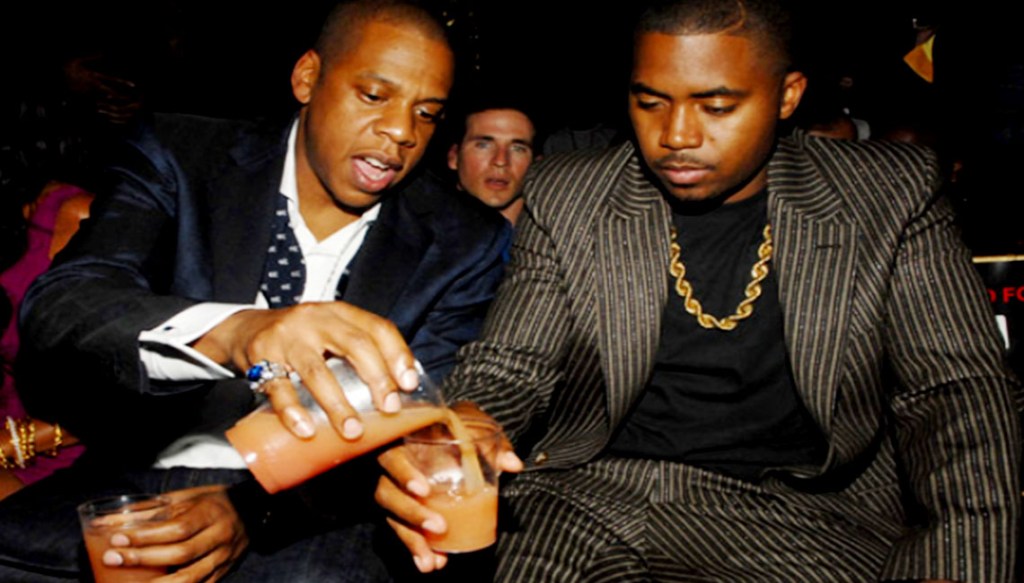
According to Chapter 5 of High Snobiety’s 2019 article on the brief history of the JAY-Z vs NAS febeef, entitled “the reconciliation”, the Hip Hop Cold War came to a cataclysmic end in approximately in the year 2005.
4 years after “Ether,” Nas’ diss track which arguably out manouvered “Jay-Z’s take over, the 2 Opposing Kings of New York decided to end their beef in front of a sold out crowd at the Continental Airlines Arena in East Ruthorford, New Jersey during JAY-Z’s ‘I Declare War’ tour in October 2005.
This article is a revisionist account of what I would like to coin as “Hip Hop’s Cold War”, whereby New York can be seen to be symbolic of the World during the post-WWII period, with its new emerging superpowers, loose alliances, ideologies and aspirations to eliminate their rival in order to secure supremacy.
If it is unfair to label Jay-Z as the Capitalist Bloc, and Nas as the Communist bloc, it would be due to the benefit of hindsight as well as the growing tolerance of ambiguity as we enter the 3rd decade of the 21st Century. In 2020, it is somewhat baffling that both these artists still possess very high levels of admiration and significance in the context of Hip Hop.
This may be due to many factors, including their crafts, as well as their affiliations with two rappers who were embroiled in a similar conflict 6 years prior, namely being Tupac and the Notorious B.I.G. The point I wish to labor home is that in 2020, 15 years after the truce, such a feud would almost be inconceivable to many born after 2005 due to the waning of a polarized Hip Hop world.
Jay-Z and Nas are both “woke” now, to lend the post-structural buzzword of the “Cancel Culture”. They are both very robust conscious rappers in their own right ……….. or at least since Jay-Z released his “4:44” album. If Capitalism is a system defined by mutation, then the representation of the iconic rivalry between Jay-Z and Nas is certainly not remote from the “cultural interpretations” of what they have each come to represent in the legacy of the past 26 years of Hip Hop.
In my opinion, Jay-Z may have won the feud which formally ended in 2005, not due to the fact that he was far superior to Nas, but rather due to the fact that Nas had unintentionally over-extended his resources and energy base in an “incandescent” fashion, to the point that he had tragically burnt through his currency, leading to a “definitive triumph” not only Jay-Z but also for the ever evolving Neo-Liberal Hip Hop industry, where profit came to supersede progress.
The irony is that, from a critical review point of view, I am strongly of the opinion that Jay-Z may have just been officially eclipsed by Nas in 2020, unless Hov can respond decisively to the final offences of attrition by Nasir Jones. The balanced combined power of the “Lost Tapes 2”, (2019) album, and of Kings Disease (2020) seem to have clinched a last minute victory for Nas.
This pulp-fictionesque historiography is based on the assumption that their last 2 individual projects would be what would be used to measure them against each other, and after careful consideration It seems to be the case that “4:44″ and “The Carters’ Everything is Love” album could be said to have been outmatched by Nas’ Lost Tapes 2 and Kings Disease.
This may be the most surreal, but gregarious “comeback” in the context of Pop Music, since Hip Hop was very much born within the era where Pop Music was also a very iconic force in the cultural imagination, even though it does not run parallel to Hip Hop anymore.
This article will probably be very harshly judged in future by Hip Hop scholars, should Jay-Z have a final solution to Nas up his sleeves in the near future, but for now, I would conclude that the “End of Hip Hop History” did not occur in 2005, and that the Cold War maintained a subtle continuity.
 The Contrarian Aquarian Platform